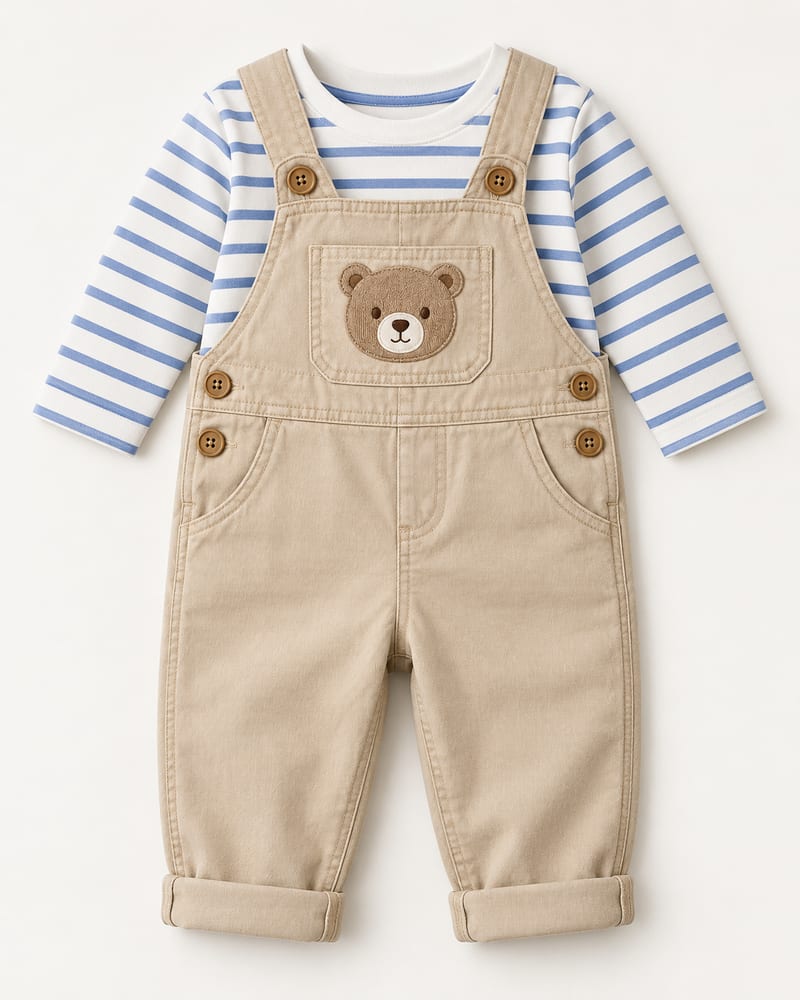
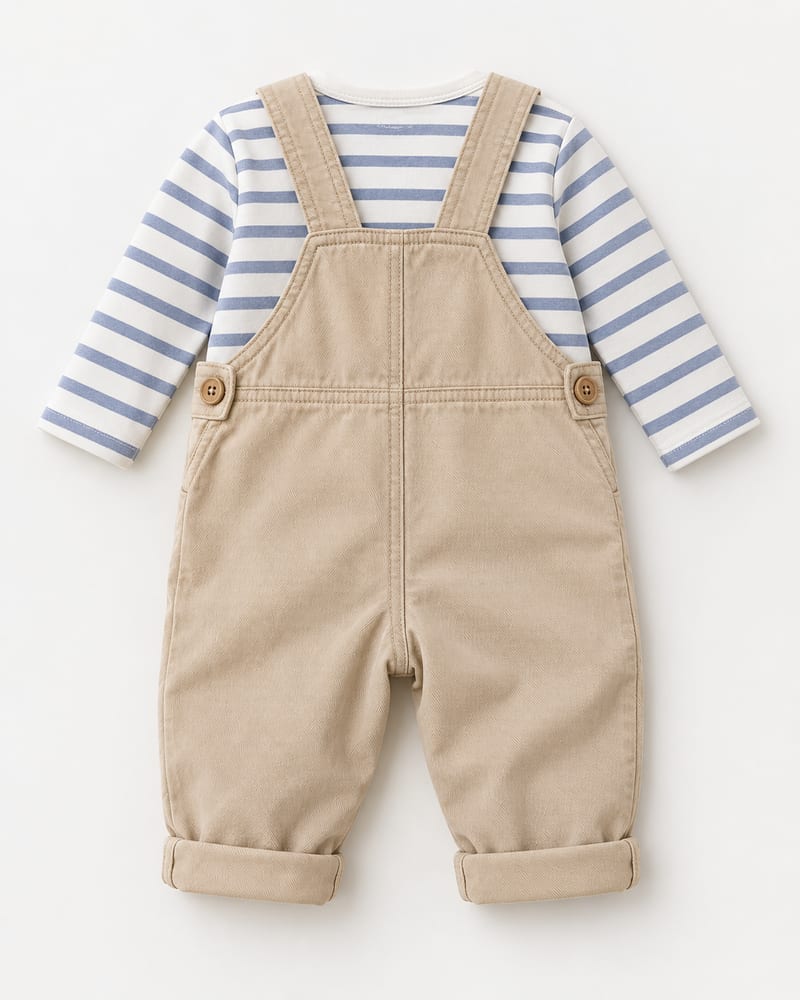
Dungarees & overalls
When can a baby start wearing dungarees?
Dungarees can be worn from the first size, but they suit babies best once they sit and crawl. How to tell your baby is ready, and what works before then.
The short answer
Your baby can wear dungarees from the very first size: our Beige Teddy Dungarees & Striped Top Set starts at 0–3M. But dungarees really earn their place in everyday wear once a baby can sit up steadily and starts to crawl, which for many babies happens somewhere in the second half of the first year. Before that, one-pieces with snaps usually do the job with less fuss.
Age is only a rough guide. What matters is what your baby is actually doing: lying down and being carried, or sitting, rolling and heading across the floor after the nearest phone charger.
Why dungarees are fiddly in the first months
None of this makes dungarees wrong for a young baby. It just means a sleepsuit or romper is usually easier for daily wear in the early months, and dungarees are more of an outfit for visits and photos.
- Nappy changes are frequent with a young baby, and each one means undoing straps or side buttons rather than a quick row of snaps.
- A baby who spends most of the day lying down or in your arms gets little benefit from a bib that keeps the tummy covered.
- Newborn legs stay curled up, so trouser legs bunch at the knees and ankles instead of hanging straight.
- A firm bib can push up towards the chin when a small baby slumps in a bouncer or reclined seat.
Signs your baby is ready for everyday dungarees
- They sit without support and stay upright while they play with a toy.
- They roll both ways, push up on their arms or rock on hands and knees.
- Their tops keep riding up and leaving the tummy bare when they are on the floor.
- Nappy changes have settled into a more predictable pattern, so undoing straps is less of a chore.
- Their knees are getting red or scuffed from tiled or marble floors.
What dungarees do well once your baby moves
A crawling baby folds and stretches in every direction. A top and joggers tend to separate at the waist, while a bib stays put over the tummy and the back. The straps carry the weight of the trousers, so nothing slides down when they pull themselves up on the sofa.
Full-length legs protect knees on hard floors, and adjustable straps mean one pair can see your baby through a growth spurt.
If you want them for a younger baby
A younger baby in dungarees is often held upright on a lap or propped in a seat. Check the bib is not pushing up under their chin in that position, and let the straps out a setting if it is.
- Choose the size by length and weight rather than age, using our size guide. A little room in the body is kinder than a snug bib.
- Put a soft long-sleeve top or bodysuit underneath so the dungaree fabric is not against bare skin.
- Check that the side buttons open fully, which makes changes quicker.
- Keep them for awake time, visits and photos rather than long, lazy days at home.
How many to start with
If your baby is not yet crawling, one pair is plenty for visits and photos. Once they are on the move and you find yourself reaching for dungarees most mornings, two or three pairs in the current size, with more tops than dungarees, is a comfortable rotation.
If you are still working out which types of clothing you need, our guide to rompers, sleepsuits, jumpsuits and dungarees explains what each one is for. Many families rely on one-pieces in the first months, then shift towards dungarees and two-piece sets once crawling starts.
Quick answers
Can a newborn wear dungarees?
Yes, as long as they fit well and there is a soft layer underneath. They are simply less practical than a sleepsuit for a newborn because of frequent nappy changes, so most parents save them for short outings or photos.
What age are dungarees best for?
They are most useful from when a baby sits and crawls until toddlerhood, roughly the 6–12M to 18–24M sizes. That is when a bib that stays in place and covered knees make the biggest difference.
Do dungarees press on a baby’s tummy when they sit?
They should not if the size is right. When your baby sits, you should be able to slide a flat hand between the bib and their tummy. If the bib digs in, let the straps out or go up a size.
Which size should I buy for a baby who is about to crawl?
Go by length and weight rather than age, using the size guide. If your baby is near the top of their current size, choose the next one up so the dungarees last through the crawling months.