Sizing & fit
Baby cap size by age: measuring for a winter hat
How to measure a baby’s head for a winter cap, typical head sizes from newborn to two years, ear flaps and ties, and signs a cap doesn’t fit.
How to measure your baby’s head
Measure around the widest part of your baby’s head, just above the eyebrows and the tops of the ears, with a soft tape, and choose the cap by that number in centimetres rather than by age. Most newborns measure somewhere around 33 to 36 cm and most two-year-olds around 46 to 49 cm, so a cap labelled with an age range can fit one baby nicely and squeeze another.
It takes less than a minute if you do it at a calm moment:
- Use a soft tailor’s tape. If you only have string or a strip of paper, mark where it meets and lay it against a ruler.
- Pick a calm moment: during a feed, or with your baby on someone’s lap holding a toy.
- Run the tape across the forehead, about a finger’s width above the eyebrows, over the tops of the ears and around the fullest part of the back of the head.
- Keep it snug but not tight, and read the number where the tape overlaps.
- Measure twice, moving the tape slightly up or down at the back, and use the larger number.
- Write it down in centimetres with the date. Heads grow quickly in the first months, so measure again before each winter purchase.
Typical head sizes by age
These rough figures sit around the middle of the WHO Child Growth Standards. Boys average slightly larger than girls, and plenty of healthy babies measure above or below them. Your doctor checks head growth at routine visits and is the right person to ask about it; for buying a cap, all you need is your own baby’s number.
- Newborn: about 33–36 cm
- 3 months: about 39–41 cm
- 6 months: about 42–44 cm
- 12 months: about 44–47 cm
- 18 months: about 45–48 cm
- 24 months: about 46–49 cm
Why age labels on caps vary
Head growth is fastest in the first six months and slows a lot after the first birthday, so a 0–6M cap has to cover a much bigger jump than a 12–24M one. Brands also cut caps differently. A stretchy knit cap labelled 0–6M might fit anything from a small newborn to a large four-month-old, while a lined fleece cap with ear flaps barely stretches at all. Some caps simply say “one size”.
If the listing gives a head size in centimetres, match it to your number. A stretchy knit cap can be the same size as the head or a touch smaller; a lined cap with little give should be the same or about a centimetre bigger. If your baby falls between two sizes, choose the larger: a loose knit brim can be folded up, but a tight one leaves marks. Our baby clothes size chart and size guide cover clothes in the same way, by measurement first.
Ear flaps, ties and pom-poms
- Ear flaps should cover the whole ear, lobe included, without folding the ear forward. The lower edge should reach just below the ear, not sit on the jaw.
- Ties should be short. A chin strap with a snap or a soft hook-and-loop fastening is better than long strings; cut very long ties shorter or choose another cap, and never knot them tightly under the chin.
- Pom-poms should be firmly sewn, so give them a firm tug before the first wear. Skip beads, sequins and buttons near the face.
- A big pom-pom or knot at the back pushes the head forward in a pram or car seat, so choose a flat back for travel.
- For a baby who pulls caps off, a snug fit does more than any fastening.
Too tight, too loose, or just right?
A cap that fits covers the forehead to just above the eyebrows, the ears and the back of the head down to the nape, and stays in place when your baby turns. You should be able to slide one finger under the brim. Signs it is wrong:
- Red lines on the forehead or behind the ears when it comes off: too tight.
- More rubbing and pulling at the head than usual: too tight or scratchy.
- The cap rides up to the crown within minutes: too small or too shallow.
- The brim slips over the eyebrows or eyes: too big, and unsafe in a pram, where it can slide over the face.
When the cap comes off
A winter cap is for outdoors. Babies lose heat through their heads, which is how they cool down, and the NHS and The Lullaby Trust advise taking hats off as soon as you come indoors and never letting a baby sleep in one, however cold the night. Take it off in the car once the heater is on, and in a warm sitting room even for a short visit. Our guide to dressing a baby for winter covers what to use instead at night.
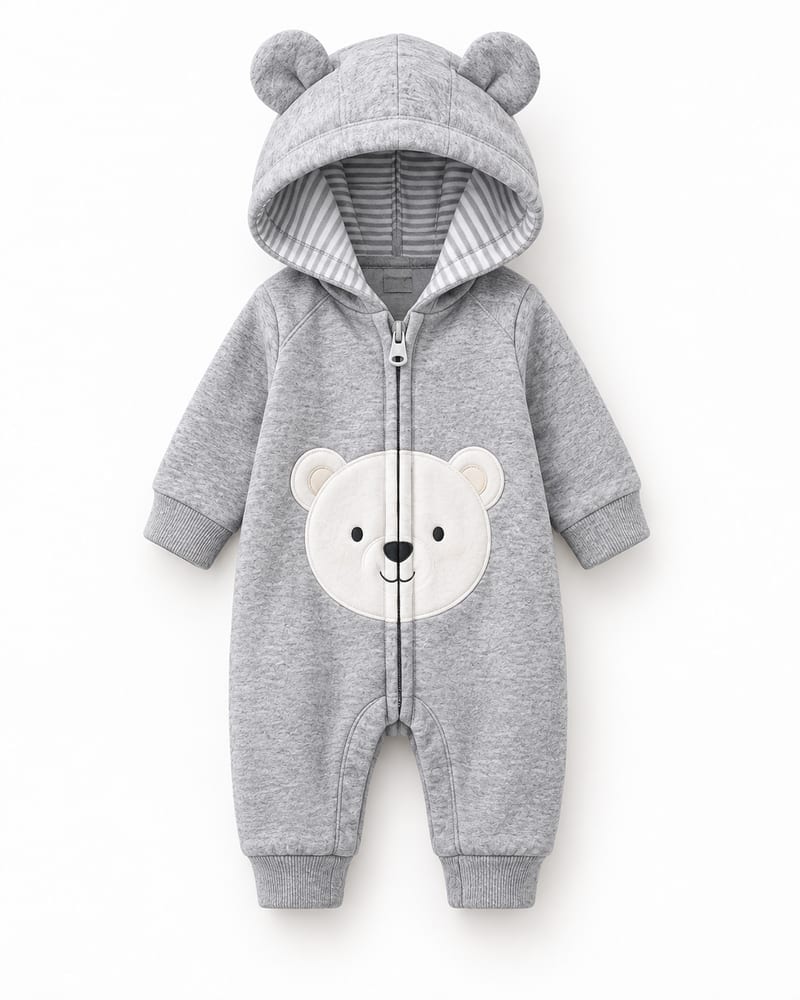
For short trips, a well-fitting hood can do the cap’s job; the Grey Bear Hooded Jumpsuit has a hood with bear ears that comes down in one movement indoors. Advice on long ties and cords on children’s clothing follows the US Consumer Product Safety Commission.
Quick answers
What size cap does a newborn need?
Most newborns measure about 33–36 cm around the head, so look for a newborn or 0–3M cap that lists a size in that range. If you are buying before the birth, one or two caps is plenty, since newborn heads grow fast.
How do I know a baby’s cap fits?
It covers the forehead to just above the eyebrows, the ears and the back of the head, stays put when your baby turns, and leaves no red marks. One finger should slide under the brim.
Are caps with ties safe?
Short ties or a chin strap with a snap are fine for an awake baby you are watching, outdoors. Avoid long strings and cords, never tie them tightly, and take the cap off for sleep and indoors.
Can my baby wear a cap at night if the room is cold?
No. Keep the head uncovered for sleep and adjust the sleepsuit and bedding to the room instead. If you are worried your baby is cold at night, ask your doctor.